

.avif)
Industrial Tubing vs Spiral Pipe
Industrial Tubing vs. Spiral Pipe: What’s the Better Choice?
When designing an industrial air handling, mist collection, fume exhaust, or dust collection system, ductwork is more than a way to move air from one point to another. The duct system affects airflow, leakage, installation time, durability, maintenance, and the cost of changing the system later.
Spiral pipe is often compared with US Duct and US Tubing simply by looking at the per-foot price of a straight section. That comparison misses the more important differences: how the pipe is made, how it is joined and sealed, how easily it can be adjusted in the field, how it responds to pressure, how long it takes to install, and whether it can be reused when the system changes.
US Duct and US Tubing are related clamp-together systems, but they are designed for different requirements. US Duct is available in welded-seam or “tubed” construction depending on the application and is intended for dust, most fumes, and general industrial air movement. US Tubing uses a different end form, gasket, and clamp design and is guaranteed leak-free for applications where air or fluid cannot be allowed to escape.
What Is Industrial Tubing?
The word “tube” needs some definition because it can describe two different constructions. One is seamless tube, extruded at the mill with no longitudinal seam. US Duct offers this type of seamless tubing for some US Tubing products. The other begins as sheet metal that is rolled until the edges meet and then continuously welded in a straight longitudinal line. This is the construction US Duct most commonly uses for its tubed products.
For diameters under 30 inches and gauges under 14 gauge, the longitudinal seam is typically laser welded. For diameters larger than 30 inches or material heavier than 16 gauge, MIG welding is used. In either welded-tube or seamless construction, the important difference from spiral is the same: the inside surface is smooth rather than interrupted by a spiral seam running continuously through the duct.
US Duct and US Tubing both use this smooth-wall concept, but their connections are different. US Duct is a rolled-lip, clamp-together system. Its clamp contains a gasket that seals around the exterior of the joint. That connection is secure and well suited for dust, most fumes, and air movement, but it is not represented as leak-free.
US Tubing is built for applications where leakage cannot be accepted. Its ends are Vanstoned—turned outward approximately 90 degrees to the tube—to form mating flanges. A formed slotted gasket fits over one Vanstoned end so that the gasket fully encapsulates that edge. The second, ungasketed end mates against it, sandwiching the gasket between the two ends. An over-center Tubing Clamp, similar in concept to the US Duct clamp, closes the joint, and an additional tightening screw allows the installer to cinch the connection tighter. The result is a connection designed and guaranteed to be leak-free for air or fluid service.
What Is Spiral Pipe?
Spiral pipe is formed differently. A coil of sheet metal—commonly about 6 to 8 inches wide—is fed through a spiral machine, wrapped helically, and mechanically formed into round pipe. This creates the familiar spiral seam and multiple layers of material at the seam.
Spiral is widely used because straight pipe can be produced economically and in long lengths, often up to 20 feet. The challenge is what happens after the straight pipe is made. Unlike a purpose-built clamp-together system, spiral does not have one standardized, adjustable connection method. Depending on the application, it may be joined with male-to-male adapters inserted into the pipe and then screwed and taped; crimped ends that slide into one another; slip-over or “Wonder” flanges that are screwed to the duct; or conventional flanges. Conventional flange attachment is complicated by the multiple layers created by the spiral seam, and welded flanges are generally not practical on the light gauges commonly used for spiral.
Regardless of the connection chosen, sealing spiral typically requires field-applied tape, caulk, or sealant. The pipe also has to be cut to relatively close dimensions, and field cutting can leave sharp or jagged edges that must be handled and fitted. There is no built-in adjustment feature comparable to US Duct or US Tubing.
Durability: Built for Industrial Demands
Construction affects more than appearance. It affects how the duct responds to industrial service and sudden changes in pressure.
Spiral is often made in lighter gauges and in lengths as long as 20 feet. That combination can make a long section more susceptible to deformation or collapse when subjected to sudden pressure changes or continuous high pressure. The spiral seam provides longitudinal structure, but the long unsupported shell can still be vulnerable depending on gauge, diameter, and operating conditions.
US Duct and US Tubing are intentionally limited to 5-foot straight lengths. Every US Duct section has a rolled lip at the end, while every US Tubing section has a Vanstoned end. Those formed ends act as circumferential strengthening elements at frequent intervals along the system. Combined with the smooth welded or seamless tube construction, they create a much more rigid assembly that resists collapse under sudden pressure changes and continuous industrial pressure demands.
This construction allows US Duct and US Tubing to meet and surpass the strength expectations commonly applied to industrial duct systems while retaining the advantages of modular clamp-together installation.
Leakage: The Hidden Cost in Duct Systems
Leakage is another area where it is important not to treat US Duct and US Tubing as the same product.
US Duct uses a gasketed over-center clamp that wraps around the exterior of two mating rolled lips. It provides a secure connection for dust collection, most fume applications, and industrial air movement. It is designed to connect quickly and securely requiring no additional tape of sealing. However, it is not guaranteed leak-free.
US Tubing is specifically designed for applications requiring no leakage of air or fluid. Its Vanstoned ends, fully encapsulating slotted gasket, over-center clamp, and clamp tightening screw work together to compress and contain the gasket at the joint. US Tubing is guaranteed leak-free, making it appropriate where the process cannot tolerate air, mist, liquid, or pressure escaping through the connections.
Spiral systems generally depend on field sealing. Screws, tapes, caulks, sealants, and slip-fit connections must be applied correctly at installation and often revisited when the system is modified. In negative-pressure systems, leaks pull unwanted air into the duct and consume system capacity. In positive-pressure systems, leaks can push air or conveyed material out. Either way, the integrity of the connection matters to system performance.
Installation: Speed, Fit, and Field Adjustability
Installation is where the difference between buying pipe and buying a system becomes especially clear.
US Duct is designed to be highly adjustable in the field. A standard 5-foot section can be cut to a liberal approximate length, removing the rolled lip and leaving a raw edge. That raw end slides into an adjustable sleeve. A rubber O-ring on the cut pipe then seals against the opposing rolled lip of the sleeve, providing as much as 11 inches of adjustment after the pipe has been cut. The collars on US Duct fittings can also receive a raw pipe end, providing several additional inches of fitting adjustment. Because the pipe itself can be cut to any required length, the installer has considerable freedom to absorb real-world dimensional differences without custom fabrication.
US Tubing provides similar straight-run adjustability through a US Tubing adjustable sleeve. Because of its leak-free Vanstoned connection design, however, the fitting collars do not provide the same raw-end adjustment available with US Duct.
Spiral offers no comparable adjustment feature. Sections must be measured and cut much closer to final dimensions. Depending on the connection method, installers then have to insert adapters or crimped ends, drill and install screws, fit flanges, and apply tape or caulk to seal the joint. Field cuts can leave jagged edges, and an error in length can mean recutting, patching, or replacing a section.
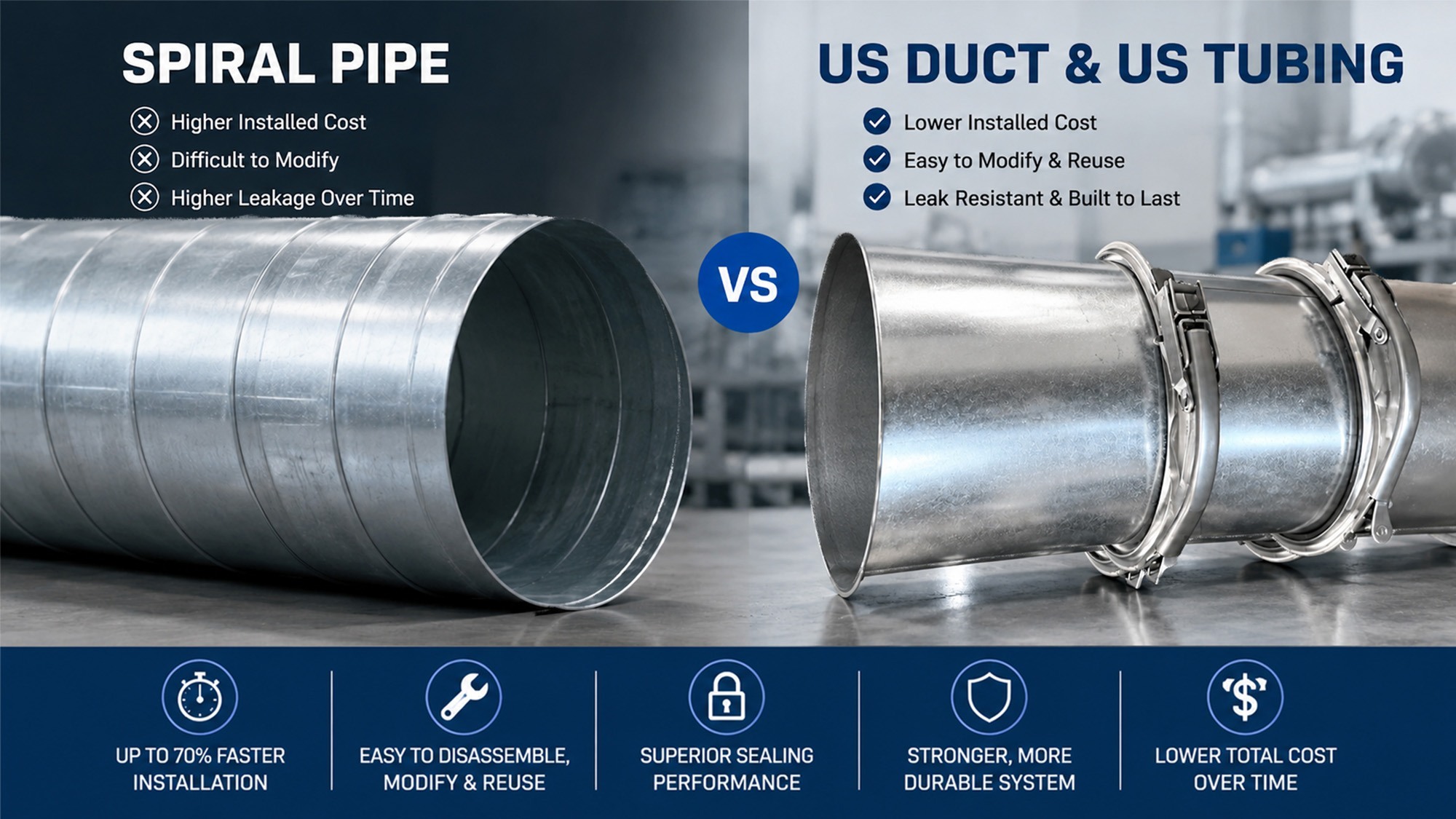
Both US Duct and US Tubing eliminate much of that field fitting and sealing work. Their clamp-together designs install in approximately 70% less time than conventional spiral installations, reducing labor and making installation more predictable.
Lifecycle Costs: Look Beyond the Initial Price
Spiral often wins the first comparison because a straight foot of spiral pipe is inexpensive. But a per-foot comparison of straight pipe is not a comparison of installed systems.
Lifecycle cost includes:
• Material cost for straight pipe and fittings
• Installation labor
• Cutting, fitting, fastening, taping, caulking, and sealing
• Leakage-related system losses where applicable
• Downtime during installation, repairs, or modifications
• Field rework caused by dimensional differences
• System reconfiguration costs
• The value of components that can be reused rather than discarded
The fittings used with spiral are often much closer in price to US Duct and US Tubing fittings than the straight-pipe comparison suggests. The real difference emerges in the labor required to turn those components into a finished system. Cutting to close dimensions, making field connections, fastening, taping, caulking, and sealing all add cost. US Duct and US Tubing are designed to remove much of that work and can reduce installation time by approximately 70%.
There is also a lifecycle advantage that is easy to overlook: US Duct and US Tubing are modular and reusable. When a machine moves, a process changes, or a system is reconfigured, the clamps can be opened and the components can be rearranged, supplemented, or reused. Spiral that has been cut, screwed, sealed, patched, or fitted for one layout is much more likely to be discarded when the system changes.
When Spiral Pipe May Be Enough
Spiral pipe remains a practical choice when the application is light-duty, the layout is simple and unlikely to change, pressure demands are modest, leakage is not a significant concern, and minimizing the initial material cost of straight pipe is the primary objective.
For basic HVAC-type air movement or other applications where field sealing, close cutting, and eventual replacement are acceptable tradeoffs, spiral can do the job economically.
When Industrial Tubing Is the Better Choice
US Duct or US Tubing becomes the better choice when the system requires:
• A smooth interior without a continuous spiral seam
• Stronger, short modular sections that resist pressure-related collapse
• Fast clamp-together installation with substantially less field labor
• Built-in field adjustability rather than close-dimension cutting
• Easy modification, disassembly, and reuse
• A secure gasketed connection for dust, most fumes, and industrial air movement — US Duct
• Guaranteed leak-free performance for air or fluid — US Tubing
The choice between US Duct and US Tubing then comes down to the application. If the requirement is a fast, strong, adjustable industrial duct system for dust, most fumes, or air movement, US Duct provides the rolled-lip clamp-together solution. If the requirement is that the system not leak air or fluid, US Tubing adds Vanstoned ends, an encapsulating gasket, and a cinch-tightening Tubing Clamp to provide a guaranteed leak-free connection.
Final Takeaway
The meaningful comparison is not “spiral versus tube” as though tube were one generic product. It is a comparison of complete systems and the requirements they are designed to meet.
US Duct can be supplied in welded-seam or tubed construction and combines a smooth interior, 5-foot modular sections, rolled-lip clamp connections, and extensive field adjustability. US Tubing uses the same modular philosophy but is engineered around a Vanstoned, gasketed connection that is guaranteed leak-free. Spiral is an economical way to manufacture long straight pipe, but its field connections typically require closer cutting, mechanical fastening, and tape or caulk for sealing, with no built-in adjustment system.
That is why comparing only the price per foot of straight pipe can be misleading. Fittings are often much closer in cost, while US Duct and US Tubing can install in approximately 70% less time. They are also designed to be taken apart, modified, and reused rather than discarded when the system changes.
The better question is not, “Which straight pipe costs less per foot?” It is, “Which system gives the application the strength, sealing, installation speed, adjustability, and lifecycle value it actually requires?”

What Facility Managers Should Know About Static Pressure

How Poor Hood Design Impacts Dust Collection Performance