
Battery Manufacturing Dust Collection: Design Considerations | US Duct
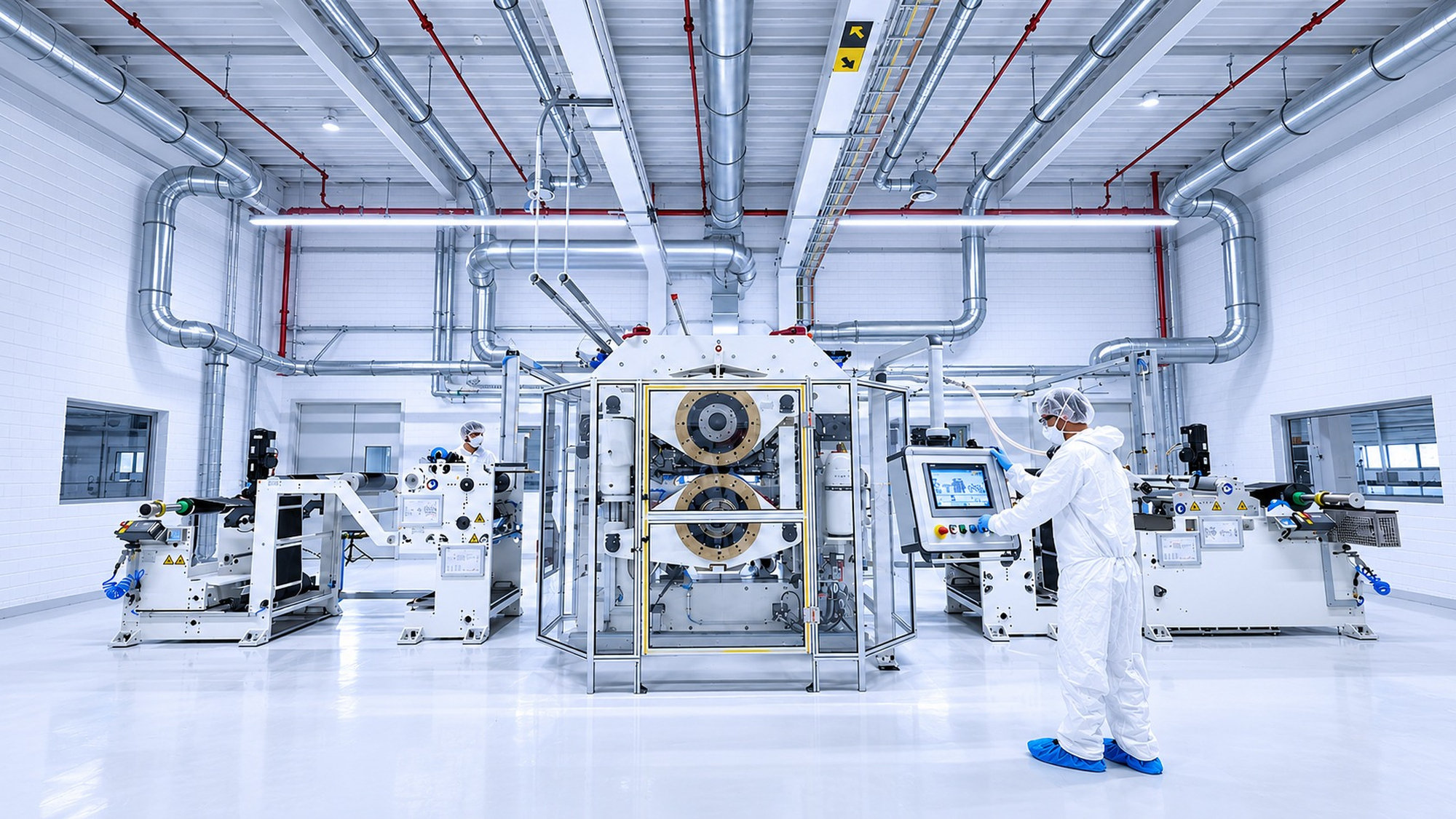
Battery manufacturing puts more demand on a dust collection system than almost any other dry process. Electrode powders are fine, often conductive, and in many cases combustible. Production runs continuously, and the process itself is sensitive to contamination. In that environment, a leak in the ductwork is not just lost suction — it is a contamination path, an exposure point, and a housekeeping problem that builds up where nobody is looking. Getting the design right up front is far easier than chasing those problems after the line is running.
Why Battery Plants Are a Different Kind of Dust Collection Problem
Every dust collection design starts with the same basic questions: how much air does each pickup need, and how fast does that air need to move through the duct to keep material suspended? Battery plants still start there, but three conditions raise the stakes:
- Particle size — cathode and anode powders are typically very fine. Fine particulate stays airborne longer, escapes through small gaps, and settles in any low-velocity section of the system.
- Combustibility and reactivity — graphite dust and many metal-bearing powders are combustible. Where lithium metal or other reactive metal dusts are present, the hazard profile changes again.
- Process sensitivity — contamination, humidity, and cross-talk between process areas affect product quality. Ductwork that pulls unfiltered room air in through leaky joints works directly against the environment the facility is trying to control.
Airflow and Transport Velocity
Each collection point needs enough capture velocity at the hood or enclosure to pull material in, and enough transport velocity in the duct to carry it all the way to the collector. With fine powders, the bigger risk is not heavy material dropping out of a horizontal run — it is gradual accumulation in places designers often overlook: tight-radius elbows, abrupt transitions, oversized branches, and dead legs left over from line changes.
- Size every branch for actual demand — design each branch for the CFM its pickup requires, then confirm transport velocity is maintained through every downstream main.
- Balance at design and after every change — an unused branch left open steals CFM from active pickups; a closed branch with no flow becomes an accumulation point.
- Account for the full pressure budget — track static pressure and SP loss across fittings, separators, and the collector so the fan is selected against a realistic fan curve.
- Choose smooth geometry — tubed elbows and gradual transitions reduce pressure drop and eliminate ledges where fine powder can settle.
Fine Particulate Containment Starts With the Duct
In a negative pressure system, a leak pulls room air into the duct. That costs CFM at the hood and forces the fan to work harder. In a positive pressure section — downstream of the fan, or in a process exhaust or conveying line — a leak pushes powder out into the work area. Either way, joints and seams are where containment fails first.
That is why battery facilities frequently specify leak-free ductwork instead of standard sheet metal duct. US Tubing is US Duct’s modular, clamp-connect industrial tubing system, built for exactly this kind of application:
- 100% leak-free — backed by the US Duct guarantee and suitable for both negative and positive pressure operation.
- Laser-welded 304 Stainless Steel — with silicone or EPDM gasket options for the process stream.
- Clamp-connect assembly — the sealing performance of flanged-and-gasketed duct with the installation speed of clamp-together duct.
- Reconfigurable — lines can be modified as chemistries, equipment, and volumes change, without hot work or re-fabrication.
Same premium airtightness. Better price. That combination is what makes leak-free tubing practical across an entire battery plant rather than only at the most critical process points.
Combustible Dust: Design With the Standards in View
Combustible dust requirements should shape the system from the first layout, not get added at the end. The references engineers most often work from for battery manufacturing include:
- NFPA 660, Standard for Combustible Dusts and Particulate Solids — effective December 2024, NFPA 660 consolidated several earlier standards, including NFPA 652 (Fundamentals) and NFPA 484 (Combustible Metals), into one document. Combustible metal requirements now sit in their own chapter. A dust hazard analysis (DHA) remains the foundation.
- NFPA 855, Standard for the Installation of Stationary Energy Storage Systems — relevant where cells and modules are formed, tested, or stored on site, and where thermal runaway risk must be managed.
- OSHA airborne particulate standards and combustible dust guidance — including OSHA’s Combustible Dust National Emphasis Program.
For the ductwork and collection system, those references translate into practical design decisions: keeping velocities high enough to prevent accumulation, bonding and grounding the duct system, using spark traps and explosion isolation valves where the hazard analysis calls for them, and locating and protecting collectors appropriately. US Duct systems are designed with awareness of applicable OSHA and NFPA standards, and our team works alongside the facility’s engineer of record and DHA findings.
Common Design Missteps in Battery Plant Dust Collection
- Using standard sheet metal duct where containment matters: Fine, combustible powder finds every gap. Positive pressure sections and contamination-sensitive areas need leak-free construction.
- Designing for today’s line only: Battery lines change often. A welded system turns every change into hot work, downtime, and scrap. A clamp-connect system turns it into a few hours of unclamping and reclamping.
- Treating the DHA as paperwork: The dust hazard analysis should drive isolation, spark mitigation, grounding, and collector protection decisions — not be filed after the system is built.
- Ignoring low-velocity sections: Dead legs, oversized branches, and abrupt transitions are where fine powder accumulates. Every section of the system needs to hold transport velocity.
Building a Battery Plant System That Holds Up
Battery manufacturing rewards systems that are engineered as a whole — capture, transport, containment, and collection designed together around the material and the hazard analysis. US Duct manufactures 100% of its products in the USA, turns quotes around in 24 hours, and provides live support from design through installation.
Planning a battery manufacturing project? Request a Quote or Contact Us to talk through airflow, containment, and material selection with the US Duct team.
Related Resources
- Designing Leak-Free Battery Rooms
- Liquid-Tight Ductwork for Battery Manufacturing Facilities
- Why Automotive and Battery Manufacturers Are Ditching Leaky Duct Systems for US Tubing
- Industrial Tubing vs Spiral Pipe
- Introduction to US Tubing
- US Tubing Case Study: Positive Pressure Ducting Solution
- Spark & Fire Problems Solved
DuctQuote Update Oct 2026
What Facility Managers Should Know About Static Pressure