
The Sticker Price Trap: Why Spiral Duct is Costing Your Plant More Than You Think
In the world of industrial dust collection, the initial quote for ducting is often a mirage. It is easy to get steered toward traditional spiral ducting because the fabrication cost, which involves simply locking metal strips together, is relatively low.
Looking at the cost per foot of pipe is like buying a car based only on the price of the chassis. In a high-stakes manufacturing environment, the only metric that actually moves the needle is Total Installed Cost. When you factor in shipping logistics, specialized labor, and the headache of maintenance, that "cheap" spiral pipe starts to look incredibly expensive.
For facilities that live and die by their uptime, switching to Clamp-Together Modular Ducting isn't just a preference. It’s a strategy.
The Logistics Gap: Shipping & Handling
Spiral duct usually shows up in long, 20-foot sections. While that sounds efficient for long runs, it creates a logistical nightmare.
- Shipping Premiums: Delivering 20-foot sections is notoriously expensive and prone to transit damage before it even reaches your dock.
- The Handling Nightmare: Try moving an oversized section of pipe through a plant. Navigating around existing machinery and lifting it into place is slow, dangerous, and eats up labor hours and dollars.
The Modular Alternative
Clamp-together duct is built in smaller, more manageable 5-foot sections. This allows for denser shipping, lower freight costs, and much easier handling once the material hits your floor.
Installation: The 70% Speed Advantage
The biggest drain on your project budget isn't the material—it's the man-hours. Traditional spiral ducting requires a labor-intensive installation process. Because you need exact field cuts, a skilled crew must measure, cut, and connect every joint on-site.
The Hidden Labor of Spiral Joining
Whether you are using barrel clamps or sheet metal screws, joining spiral is a meticulous ordeal. No one enjoys drilling through heavy-gauge metal while balancing on a lift.
Construction or Assembly?
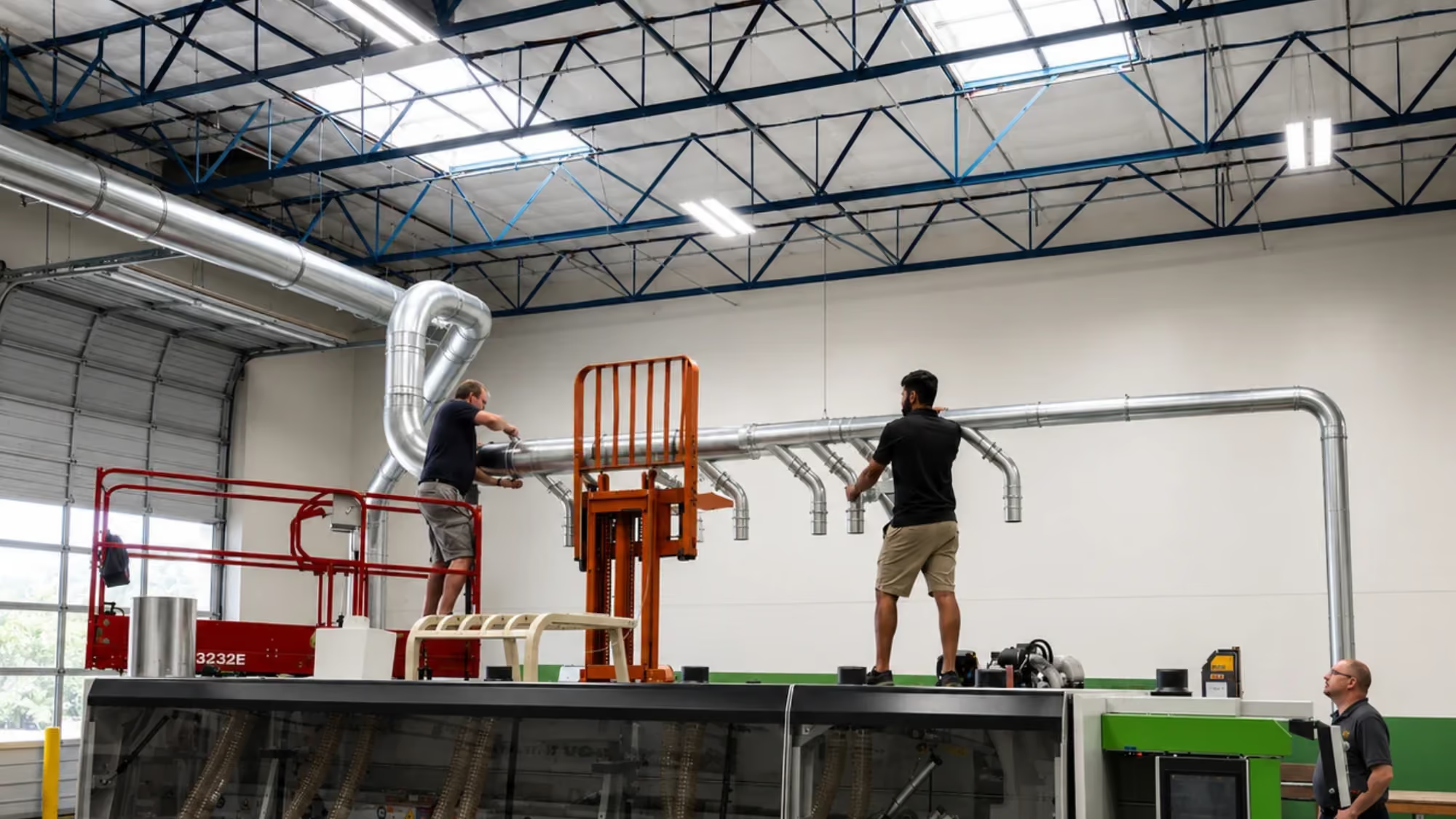
Clamp-together systems change the math entirely. By using a precision-engineered rolled lip and reusable clamps, the process stops being "construction" and starts being "assembly":
- Up to 70% Faster: While a spiral crew is still busy drilling and riveting, a modular team is already testing the system.
- The “Sleeve Advantage”: An adjustable sleeve slides over a cut piece of pipe to create a telescoping effect. This gives you infinite adjustment without needing a perfect measurement every time.
Maintenance & Downtime: The 5-Minute Clog Clear
In an industrial environment, system maintenance is not a matter of if, but when. Whether it is a surge in material or moisture in the lines, a clogged duct is an immediate threat to your production schedule.
The 5-Minute Rule
With a quick clamp clamp-together, modular system, maintenance personnel can simply open the clamp, remove a section by hand, clear the obstruction, and reassemble it back into place. No cutting. No drilling. No extended downtime.
Easier access actually encourages preventative maintenance—helping you stay compliant and avoid performance losses that lead to bigger, more costly failures.
Scalability: A Reusable Asset
A modern manufacturing facility is never static. You add machines, reconfigure work cells, and expand departments. With traditional spiral duct, your floor plan is effectively static. Because the pipe is cut-to-fit and joined, any layout change results in a pile of wasted material.
You don’t just move spiral duct. You scrap it.
Keep Your Investment on the Shop Floor
Clamp-together ducting, however, is a reusable asset. You can unclamp an entire run and move it to a new department or access that new machine…keeping your investment on the shop floor rather than in the recycling bin.
Conclusion: Calculating the True Winner
If you are building a facility for the long haul, the choice is clear—clamp-together duct. While the fabrication cost of spiral ducting is low, the Total Installed Cost is almost always higher once you account for the 70% faster installation, easier logistics, and the elimination of specialized labor.
Do not just buy pipe. Buy a clamp-together system that grows and scales with your facility.
A Contractor’s Checklist for Successful Dust Collection Installations