

.avif)
What Facility Managers Should Know About Static Pressure
Most facility managers hear “static pressure” and assume it's an engineer's problem — something that gets set once when the system is designed and doesn't need a second thought after that. In practice, static pressure is one of the best day-to-day indicators of how a dust collection system is actually performing, and it changes constantly as filters load, dampers get adjusted, and duct runs pick up wear. You don't need an engineering degree to keep an eye on it — you just need to know what it's telling you.
Static Pressure, in Plain Terms
Static pressure (SP) is the total resistance the fan has to overcome to pull or push air through the entire system — every hood, every foot of duct, every fitting, and the filter or collector itself all add resistance. Think of it the way you'd think about drinking through a straw: air (or a milkshake) moves easily through a short, wide, clean straw. Add length, narrow it, or let it get partially clogged, and the same effort moves a lot less. The fan is the mouth doing the pulling — it can only work as hard as it's built to, and static pressure is what tells you how hard it's currently having to work.
Every fan has a fixed relationship — called a fan curve — between static pressure and CFM (the volume of air it actually moves) at a given speed. As SP rises, CFM drops. That's not the fan malfunctioning; it's the fan doing exactly what its curve says it will do under more resistance. Which means a sudden drop in airflow at a machine is rarely a “fan problem.” It's almost always an SP problem somewhere in the system.
Why This Matters on the Floor
Static pressure creeps up gradually, and the operational signs usually show up before anyone runs a formal check:
• Weaker pickup at certain machines — especially the drops farthest from the fan, even though nothing about that station changed.
• Dust or debris accumulating in duct runs where air used to move it through cleanly, because reduced velocity lets material settle out. In combustible dust environments, that's also a housekeeping and fire-code concern under NFPA guidance.
• More frequent bag or filter changes than the maintenance schedule calls for, which is often the first real clue that SP has been trending up for a while.
• Higher motor amp draw as the fan works harder against rising resistance to move the same air — a real, measurable energy cost.
• Blast gates that have to be adjusted further open at more stations just to get acceptable performance, without anyone tracking why.
None of these show up on a maintenance calendar. They show up as a slow decline that eventually looks like “the system just isn't what it used to be” — when the real story is a static pressure trend nobody was watching.
Common Missteps Facility Teams Make with Static Pressure
1. Treating SP monitoring as an engineering-only concern.
SP is set at design time, but it doesn't stay put. Filters load, gaskets wear, and gates get bumped. Without floor-level monitoring, nobody notices until performance is visibly bad.
2. Waiting for visible symptoms instead of tracking the trend.
Dust on the floor or a weak-pulling hood is a lagging indicator. A rising differential pressure reading across the filter or baghouse is the leading one — and it's usually available well before anything looks wrong on the floor.
3. Adding a new drop or machine without checking the SP budget.
Every hood and duct run shares the same fan and the same pressure budget. Tapping in a new station without rebalancing can starve airflow at existing stations, even if the new connection looks fine on its own.
4. Treating blast gates as a set-it-and-forget-it fix.
Gates are a balancing tool, not a one-time adjustment. A gate opened wider to compensate for weak pickup is often masking an SP problem elsewhere rather than solving it.
5. Assuming weak suction means a bad fan.
More often it's a loaded filter, a gate closed somewhere else in the system, or a duct restriction — all of which show up as an SP problem before they show up as a fan problem.
6. Scheduling filter and bag maintenance by the calendar instead of by pressure reading.
A calendar-based schedule either wastes a service call on a filter that still has life left, or leaves a loaded filter running well past the point where it's costing airflow and energy.
Practical Ways to Keep Tabs on Static Pressure
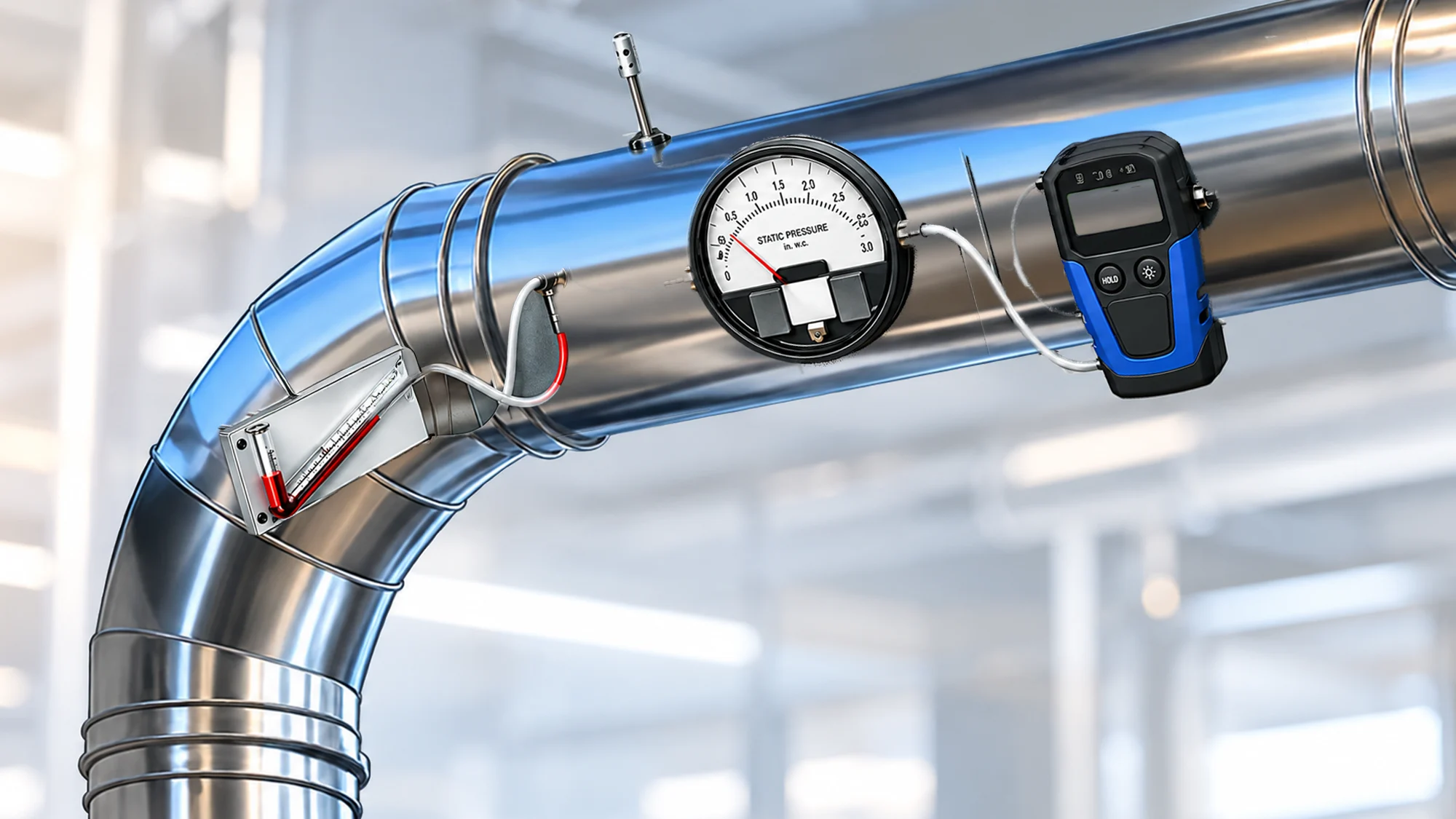
• Know your starting point. Record the baseline SP readings at commissioning — at the fan inlet, across the filter/baghouse, and at key branch points — so there's something to compare against later.
• Watch the filter differential. The pressure differential across the filter or bag media is the single most useful facility-level reading. Rising differential over time means the filter is loading; a sudden jump usually means something changed.
• Log readings on a regular interval, not just when something feels off. A quick reading at a few fixed points, logged on a simple schedule, turns static pressure from an abstract spec into an early-warning system.
• Treat any system change as an SP event. Changes to hoods, ductwork, or added stations should come with a quick SP check, not just a visual tie-in.
Getting Static Pressure Working for You
A system that's engineered around a documented pressure budget — rather than assembled and hoped for — makes all of this far easier to manage day to day. US Duct designs systems with that budget accounted for up front, and builds in the practical things that make ongoing monitoring realistic on a working shop floor: accessible pressure tap points, quick-change hoppers and baghouse access that make filter service fast enough to actually happen on schedule, and field-adjustable CTD connections that let a duct run be corrected or rebalanced without re-piping the whole system.
Static pressure isn't something to set once and forget. Treated as an ongoing operational reading — not just a design spec — it becomes one of the simplest ways to catch a developing problem before it costs real downtime.
Not sure what your system's pressure budget should look like? Request a Quote or Contact US, and US Duct can walk through it with you.
Related Resources
• Design an Industrial Ventilation System in Three Steps
• Your Dust Collection Sucks… But It Should Suck Better (Webinar)
• You're Using Your Dust Collector Wrong (Webinar)
• How to Boost Dust Collection & Waste Management Efficiency
• Dust Collection Basics: Keeping Operations Clean, Safe, and Productive
• Manual Blast Gate — No Leaks and No Seals Specs
How Poor Hood Design Impacts Dust Collection Performance
DuctQuote Update Sept 2026 | US Duct